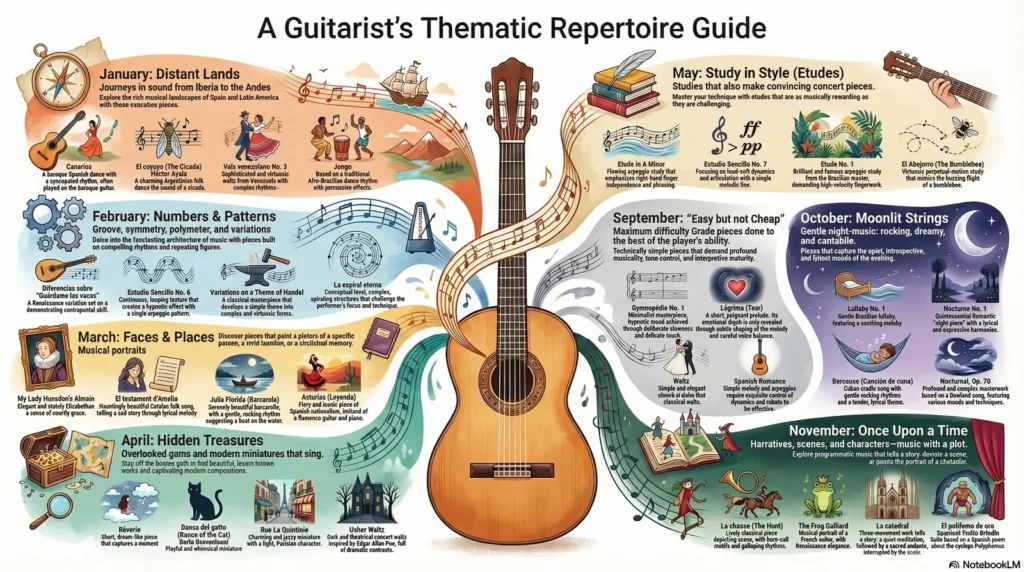

We’ve got some great monthly themes for 2026, and I always love seeing what pieces our members find that I’ve never heard of! But if you’re stuck for ideas and wanted some quick inspiration inspiration, I’ve (lazily) made this blog post for you.
I uploaded the syllabi of some leading international examination boards — the Associated Board of the Royal Schools of Music (ABRSM), RSL Awards, the University of South Africa (Unisa), and The Royal Conservatory of Music (RCM) and Trinity College of Music (TCL) — into NotebookLM and asked it to suggest some works from the syllabi matching each month’s theme. I’ve aimed to find something for every proficiency level.
Important! AI tools like NotebookLM can “Hallucinate” or dream up non-existent references and works. I haven’t gone through everything here with a fine-toothed comb yet, so you may discover some works you’ve never heard of (and neither has anyone else!) I’ll try to weed these out as I discover them.
Defining Proficiency Levels
I’ve grouped pieces in three core proficiency levels, which correspond to the grade levels of the source syllabi. This progression ensures a logical and steady development of both technical and musical skills. ABRSM, TCL and Unisa have Grades 1-8 and then diplomas, RCM has 10 grades.
• Beginner: Corresponds to Initial/Debut, Pre-Grade 1, Preparatory, and Grades 1 through 3. This stage focuses on establishing solid foundational skills in posture, tone production, rhythm, and note-reading.
• Intermediate: Corresponds to Grades 4 through 6. This stage builds upon the foundation by introducing more complex techniques, a wider expressive range, and more sophisticated repertoire.
• Advanced: Corresponds to Grades 7 and 8 and above. This stage challenges students to achieve a high level of technical mastery, develop a mature musical voice, and tackle cornerstone works of the classical guitar literature.
January: Distant Lands
The “Distant Lands” theme serves as a vibrant gateway to the heart of the classical guitar repertoire. The instrument has long been a vessel for folk traditions and nationalistic expression, and by exploring this music, from the rich traditions of Iberia and Latin America to the evocative folk melodies of wider Europe, members are immediately immersed in a vocabulary of compelling rhythms, expressive techniques, and a palette of harmonic colours fundamental to the guitar’s identity. This exploration provides a powerful and motivating start to the year’s journey.
Beginner Repertoire (Debut – Grade 3)
| Piece Title | Composer/Arranger | Suggested Grade(s) | Source Syllabus |
|---|---|---|---|
| Ojos Azules | Andean Folk Song, arr. Rivoal | Debut | RSL |
| Spanish Knights | Longworth & Walker | 1 | ABRSM |
| Seville | Peter Nuttall | 1 | RSL |
| Inés | Trad. Spanish, arr. Bonell | 2 | ABRSM |
| Tango pour Mario | Gérard Montreuil | 2 | RCM |
| Bahamas | Gérard Montreuil | 2 | RCM |
| Cueca | Yvon Rivoal | 3 | RSL |
Intermediate Repertoire (Grades 4 – 6)
| Piece Title | Composer/Arranger | Suggested Grade(s) | Source Syllabus |
|---|---|---|---|
| Vals poético No. 1 | Granados, arr. Batchelar & Wright | 4 | ABRSM |
| Tango | Tatiana Stachak | 4 | RSL |
| Tango | attrib. Tárrega, arr. Sanderson | 5 | ABRSM |
| Diferencias sobre Guardame las Vacas | L. de Narvaez | 6 | Unisa |
| Maria-Luisa (Mazurka) | Julio Salvador Sagreras | 6 | RSL |
| Valseana | Sergio Assad | 6 | RCM |
| Xaranga do Vôvô | Celso Machado | 6 | RSL |
Advanced Repertoire (Grades 7 – 8)
| Piece Title | Composer/Arranger | Suggested Grade(s) | Source Syllabus |
| Un Dia de Novembre | Leo Brouwer | 7 | RSL |
| Our Spanish Love Song | Haden & Metheny | 7 | RSL |
| Soleares (from Hommage à Tárrega) | Joaquín Turina | 8 | ABRSM |
| Tango en skaï | Roland Dyens | 8 | ABRSM |
| Capricho Árabe | Francisco Tárrega | 8 | RSL |
| Suite del Plata, No 1 or No 2 | Máximo Diego Pujol | 8 | Unisa |
| Mazurka-Choro | Heitor Villa-Lobos | 8 | Unisa |
| Vals, op 8 no 4 | Agustín Barrios | 8 | Unisa |
From the vivid landscapes and folk traditions of distant lands, we turn inward to examine the abstract architecture of musical form.
February: Numbers & Patterns
This theme places a strategic focus on the mathematical elegance and structural logic that underpins music. By concentrating on pieces built from clear patterns, ostinatos, and formal structures like theme and variations, members can explore exceptional rhythmic precision and a deeper understanding of musical construction. This celebration of groove, symmetry, counterpoint, and polyrhythm might appeal to those members who enjoy a connection between music and mathematics.
Beginner Repertoire (Debut – Grade 3)
| Piece Title | Composer/Arranger | Suggested Grade(s) | Source Syllabus |
| Study in C, No. 1 | Fernando Sor | Debut | RSL |
| Ostinato | Norbert Kraft | 1 | RCM |
| Ecstatic Chromatic | Nick Powlesland | 3 | RSL |
| Étude No. 1 | Leo Brouwer | 3 | RSL |
| Saltarello del predetto ballo | V. Molinaro, arr. Wright | 3 | ABRSM |
| Spider | Richter | 1 | TCL |
| Cinq-huit (Five-Eight) | Ourkouzounov | 3 | TCL |
Intermediate Repertoire (Grades 4 – 6)
| Piece Title | Composer/Arranger | Suggested Grade(s) | Source Syllabus |
| Stomping the Blues | Peter Wrieden | 4 | ABRSM |
| Line by Line | Christopher Norton | 4 | TCL |
| Garden Steps | Andrew York | 4 | RSL |
| Nothing Else Matters | Metallica | 4 | RSL |
| Take Five | Paul Desmond, arr. James | 5 | ABRSM |
| 25 études esquisses, No. 3 | Gerald Garcia | 5 | ABRSM |
| Can she excuse | John Dowland | 6 | Unisa |
| Variations on a Theme of Handel | Mauro Giuliani | 6 | RCM |
Advanced Repertoire (Grades 7 – 8)
| Piece Title | Composer/Arranger | Suggested Grade(s) | Source Syllabus |
| Allemande (from Suite BWV 996) | J. S. Bach | 7 | ABRSM, RSL |
| Chromatic Fughetta No. 1 or 2 | Robert Benedict | 7 | RCM |
| Pavanas por la D | Gaspar Sanz | 7 | TCL |
| Gigue (from Suite BWV 997) | J. S. Bach | 8 | ABRSM |
| Variations on a theme by Handel, op 107 | Mauro Giuliani | 8 | Unisa |
| Introduction and Variations on “Marlborough goes to war”, op 28 | Fernando Sor | 8 | Unisa |
| Gavotte I and II, BWV 995 | J. S. Bach | 8 | RSL |
| Adana (jhaptal) | Kruisbrink | 8 | TCL |
Having explored the abstract beauty of patterns, we now apply our skills to the deeply personal art of musical portraiture.
March: Faces & Places
The “Faces & Places” theme encourages members to move beyond the notes on the page and become musical storytellers. By engaging with repertoire that depicts characters, historical figures, or evocative locations, students learn to use technique in service of interpretation. This theme is an exercise in imagination, challenging the player to use tone colour, articulation, and dynamic shaping to paint vivid sonic pictures, thereby developing a more personal and communicative performance style.
Beginner Repertoire (Debut – Grade 3)
| Piece Title | Composer/Arranger | Suggested Grade(s) | Source Syllabus |
| The Secret City | Laura Snowden | Debut | RSL |
| Havana Good Time | Longworth and Walker | 1 | TCL |
| The Old Castle | Musorgsky, arr. Hegel | 1 | ABRSM |
| Underground Sound | Gary Ryan | 1 | ABRSM |
| Mr Dowland’s Midnight | J. Dowland, arr. Batchelar | 2 | ABRSM |
| Song for a Friend | Laura Snowden | 2 | RSL |
| Killeybegs Jig | Linnemann | 2 | TCL |
| Walking with Grandma | Laura Snowden | 3 | RSL |
| The Pink Panther | Henry Mancini | 3 | RSL |
Intermediate Repertoire (Grades 4 – 6)
| Piece Title | Composer/Arranger | Suggested Grade(s) | Source Syllabus |
| West Coast | Helen Sanderson | 4 | RSL |
| Soldatenmarsch (Soldier’s March) | Robert Schumann | 4 | RCM |
| I Spy | Colin Downs | 4 | ABRSM |
| Stonehenge | Fellow | 5 | TCL |
| African Sunset | Giorgio Serci | 5 | RSL |
| Jazzy Jump Antelope | Avril Kinsey | 5 | Unisa |
| Maria Luisa | Sagreras | 5 | TCL |
| Torija | Moreno Torroba | 6 | TCL |
| The Deserted Garden | Florence Price | 6 | RSL |
Advanced Repertoire (Grades 7 – 8)
| Piece Title | Composer/Arranger | Suggested Grade(s) | Source Syllabus |
| Belle | José Ferrer | 7 | ABRSM |
| Julia Florida | Barrios | 7 | TCL |
| Rosita | Tarrega | 7 | TCL |
| Ticklin’ Toes | Florence Price | 7 | RSL |
| Homenaje, le tombeau de Claude Debussy | Manuel de Falla | 7 | RCM |
| The Earl of Essex, his Galliard | J. Dowland | 8 | TCL |
| El catalán | Brocá | 8 | TCL |
| Any one of Five Pieces from Venezuela | Vicente Emilio Sojo | 8 | Unisa |
| Schnee in Istanbul | Carlo Domeniconi | 8 | ABRSM |
Our journey through well-known musical scenes now takes a turn toward discovering works that lie off the beaten path.
April: Hidden Treasures
This theme is dedicated to the joy of discovery. “Hidden Treasures” encourages students to broaden their musical horizons by exploring compelling works beyond the standard teaching canon. The focus is on overlooked historical gems and engaging miniatures by contemporary composers. This exploration not only expands a student’s repertoire but also fosters curiosity, independence, and a deeper appreciation for the vast and varied landscape of classical guitar music.
Beginner Repertoire (Debut – Grade 3)
| Piece Title | Composer/Arranger | Suggested Grade(s) | Source Syllabus |
| The Wobbegong Waltz | Abigail James | Prep | ABRSM |
| In My Heart | Laura Snowden | 1 | RSL |
| Snake in a basket | Gary Ryan | 1 | TCL |
| Le Douze de Décembre | Ignatius Sancho | 2 | RSL |
| Magnetic South | Lee Sollory | 2 | RSL |
| La Jour de May | Ignatius Sancho | 3 | RSL |
| Kurpie Etude | Tatiana Stachak | 3 | TCL |
Intermediate Repertoire (Grades 4 – 6)
| Piece Title | Composer/Arranger | Suggested Grade(s) | Source Syllabus |
| Country Étude | Tatiana Stachak | 5 | RSL |
| Paseo | Eduardo Sainz de la Maza | 5 | RSL |
| Valse for Ernesto | Abri Jordaan | 5 | Unisa |
| Winter Story | Drozdzowski | 6 | TCL |
| Promise | Yvonne Bloor | 6 | RSL |
| Romance (1978) | Frantz Casseus | 6 | RSL |
Advanced Repertoire (Grades 7 – 8)
| Piece Title | Composer/Arranger | Suggested Grade(s) | Source Syllabus |
| Forgotten (no 77. Impromptu) | Madame Sidney Pratten | 7 | TCL |
| Serenade | Sofia Gubaidulina | 7 | TCL |
| Study No. 18 | Mario Gangi | 8 | ABRSM |
| Sonata No. 4, ‘La breve’ | Reginald Smith Brindle | 8 | ABRSM |
| On Sunday (Dance) | Frantz Casseus | 8 | RSL |
| Reboliço | João Pernambuco | 8 | RSL |
Having unearthed these diverse works, we now sharpen our focus on the specific and vital genre of the concert study.
May: Study in Style (Etudes)
This month is devoted to the concert etude, a genre that masterfully bridges the gap between technical exercises and performance repertoire. An etude is designed with a dual purpose: to isolate and conquer a specific technical challenge—be it slurs, arpeggios, or scales—and to stand alone as a convincing and expressive musical work. This focus helps us players understand that technique is not an end in itself, but the essential tool for achieving artistic expression.
Beginner Etudes (Debut – Grade 3)
| Etude Title/Number | Composer | Suggested Grade(s) | Source Syllabus |
| Pour trouver les notes 1 (no. 1 from op. 60) | Fernando Sor | Prep | RCM |
| March (No. 19 from op. 60) | Fernando Sor | 1 | ABRSM |
| Lyrical Study No. 13 | Richard Miles Jackman | 1 | RCM |
| Leçon in C (No. 2 from op. 60) | Fernando Sor | 2 | ABRSM |
| Valse (No. 7 from op. 59) | Matteo Carcassi | 3 | ABRSM |
| Estudio | Francisco Tárrega | 3 | RSL |
Intermediate Etudes (Grades 4 – 6)
| Etude Title/Number | Composer | Suggested Grade(s) | Source Syllabus |
| Étude No. 8 (from Études simples) | Leo Brouwer | 4 | ABRSM |
| Étude in F (No. 16 from 25 études, Op. 60) | Matteo Carcassi | 5 | ABRSM |
| Étude No. 6 (from Études simples) | Leo Brouwer | 5 | ABRSM, RSL |
| 25 études esquisses, No. 11 | Gerald Garcia | 5 | Unisa |
| Etude in A Minor, op. 60, no. 7 | Matteo Carcassi | 6 | RCM |
| Exercice 17 or 22 (from op. 35) | Fernando Sor | 6 | RCM |
Advanced Etudes (Grades 7 – 8)
| Etude Title/Number | Composer | Suggested Grade(s) | Source Syllabus |
| Andante allegro (No. 9 from 12 études, Op. 6) | Fernando Sor | 7 | ABRSM |
| Estudio No. 18 in E-flat Major | Fernando Sor | 7 | RSL |
| 25 études mélodiques et progressives, op. 60, No. 19 | Matteo Carcassi | 7 | RCM |
| Étude No. 5 | Ida Presti | 8 | RSL |
| 10 Etudes, No. 7 & 8 | Giulio Regondi | 8 | Unisa |
Having refined our interpretative skills through the etude, we now deconstruct the very fabric of guitar composition by analyzing masterful arrangements.
June: Composition and Arrangement
The examination syllabi are rich with masterful arrangements of folk songs, orchestral works, and popular music. If you’re not submitting an original composition, consider trying your hand at an arrangement! Failing that, try to analyse some great arrangements to see why they work. By deconstructing these arrangements, we can learn fundamental principles of voicing, harmony, texture, and instrumental adaptation.
Below is a selection of arrangements from the syllabi that offer excellent insight into the arranger’s craft.
• Holst, I vow to thee, my country, arr. Mermikides (ABRSM Grade 1): This arrangement preserves a noble melodic line while creating a simple, supportive harmony playable by a beginner. Students learn the crucial skill of balancing melody and accompaniment, ensuring the theme sings clearly above the harmony.
• Musorgsky, The Old Castle, arr. Hegel (ABRSM Grade 1): Sourced from the famous piano suite, this piece demonstrates how to capture the essence of a larger work. By studying this, a student learns how to imply multiple musical lines—the lyrical saxophone melody and the trudging piano accompaniment—within a single, coherent guitar part.
• David Guetta feat. Sia, Titanium, arr. Harrison/Hards (RSL Grade 1): This arrangement skillfully translates the electronic texture and vocal power of a pop anthem through a combination of percussive bass notes and a clear, singing melody in the upper register, teaching students how to separate and define distinct musical layers.
• Smetana, Vltava (from Má vlast), arr. Ryan (ABRSM Grade 4): Taking a famous orchestral tone poem and adapting it for solo guitar is a significant challenge. The arrangement uses flowing arpeggios and careful voicing to evoke the original orchestral texture, teaching students how to use the guitar’s resonant qualities to create an illusion of space and color.
• John Williams, Star Wars (Main Theme), arr. Hards (RSL Grade 4): This arrangement captures the heroic, brass-driven fanfare of the iconic film score. By studying this arrangement, students learn how to create a powerful orchestral tutti effect on a solo instrument through the use of open-string bass notes and full, resonant chord voicings.
• Seal, Kiss from a Rose, arr. Harrison/Rattenbury (RSL Grade 6): Translating this intricately layered 90s pop hit requires careful attention to its unique waltz-time feel. The arrangement uses counterpoint and arpeggiated chords to suggest the rich background harmonies, teaching the student how to manage complex textures and maintain rhythmic drive.
July & December: Celebration Concerts
These two months are dedicated to the art of performance. Having spent the preceding months exploring new themes and repertoire, members are encouraged to select and polish a favourite piece. The goal is to prepare for a celebratory concert, providing a valuable opportunity to share their progress and passion with members, friends, and family in a supportive and encouraging setting. No new repertoire is introduced during this time.
September: “Easy but not Cheap”
The theme of “Easy but not Cheap” is an exercise in deep musicality. It involves revisiting foundational repertoire from the beginner and early-intermediate levels with the sophisticated mindset of a more advanced player. The goal is not technical challenge, but artistic refinement. This focused work encourages the student to perfect every detail—achieving the most beautiful tone, the most elegant phrasing, and the highest level of musical polish on pieces that may seem simple on the surface but offer profound opportunities for artistry.
Here are some examples:
• Andantino by Aguado (ABRSM Grade 1): An ideal piece for perfecting a pure, singing cantabile melody. The focus here is on seamless legato and practicing fine control over the crescendo-diminuendo shape of a two-bar phrase.
• Song for a Friend by Laura Snowden (RSL Grade 2): This piece invites a deep dive into tone color and narrative. Students can experiment with varied touch (apoyando vs. tirando, playing near the bridge vs. over the soundhole) to convey the gentle, storytelling quality of the music.
• Waltz, Op. 241, No. 21 by Ferdinando Carulli (RSL Grade 3): A perfect vehicle for refining rhythmic grace. The challenge is controlling the articulation between the bass note and the upper chords to achieve a true “oom-pah-pah” feel with stylistic lift and forward momentum.
• Soldatenmarsch (Soldier’s March) by Robert Schumann (RCM Level 4): This piece demands impeccable rhythmic clarity. An advanced player can refine the crispness of the dotted rhythms and the character of the detached notes to create a performance of military precision and wit.
• Pastorale by Matteo Carcassi (ABRSM Grade 4): An excellent study in creating atmosphere and controlling texture. The focus is on sustaining the peaceful mood through subtle phrasing and maintaining a clear dynamic distinction between the gentle melodic figures and their drone-like accompaniment.
Next, we move into the gentle and expressive world of night music.
October: Moonlit Strings
“Moonlit Strings” focuses on the art of creating atmosphere and sustaining a beautiful, singing tone (cantabile). This theme centers on gentle, lyrical, and often melancholic repertoire, such as nocturnes, romances, and berceuses. These pieces present the profound challenge of mastering quiet dynamics, shaping long melodic lines, and using subtle variations in tone color to evoke a sense of dreaminess and introspection. It is an essential study in tonal control and expressive depth.
Beginner Repertoire (Debut – Grade 3)
| Piece Title | Composer/Arranger | Suggested Grade(s) | Source Syllabus |
| Andante in C | Mauro Giuliani | Debut | RSL |
| Moonlight | Stepan Rak | 1 | RCM |
| Serenade (from An den Mond, D. 259) | Schubert, arr. Kenyon | 2 | ABRSM |
| Romance | Gérard Montreuil | 2 | RCM |
| Nuit étoilée | Ogawa | 2 | TCL |
| Andante (No. 6 from Schule für die Guitare) | J. K. Mertz | 3 | ABRSM |
| Suo Gân | Trad. Welsh, arr. Goss | 3 | ABRSM |
| Adagio | J. K. Mertz | 3 | Unisa |
Intermediate Repertoire (Grades 4 – 6)
| Piece Title | Composer/Arranger | Suggested Grade(s) | Source Syllabus |
| Nightfall | Panteleimon Michaeloudis | 4 | ABRSM |
| Romance (Adagio) (No. 9 from Schule für die Guitare) | J. K. Mertz | 4 | ABRSM |
| A Lament | Madame Sidney Pratten | 4 | RSL |
| Lágrima | Francisco Tárrega | 5 | RSL |
| Norcturne No.1 or 2 | Johann Kaspar Mertz | 6 | RCM |
| Moonlight Rose | Naoko Ikeda | 6 | RSL |
Advanced Repertoire (Grades 7 – 8)
| Piece Title | Composer/Arranger | Suggested Grade(s) | Source Syllabus |
| La melanconìa (No. 7 from Giulianate) | M. Giuliani | 7 | ABRSM |
| Forgotten | Madame Sidney Pratten | 7 | RSL |
| Prélude No. 3 in A minor | Heitor Villa-Lobos | 7 | ABRSM, RSL |
| Nocturnal | Britten | 8 | RCM ARCT |
| Romanze | Niccolò Paganini | 8 | RSL |
| Estudio sin Luz | Segovia | 8 | TCL |
| Nocturne (Reverie) | Regondi | Performance Licentiate | Unisa |
The atmospheric storytelling cultivated in this theme provides a perfect foundation for exploring more explicit narrative forms.
November: Once Upon a Time
This theme, “Once Upon a Time,” focuses on the rich tradition of programmatic music—works specifically intended to tell a story, depict a scene, or portray a character. Engaging with this repertoire encourages students to analyze musical form as a narrative arc, identifying moments of tension, climax, and resolution. They learn to use their full range of technical and expressive tools to convey a plot, transforming their performance from a series of notes into a compelling tale.
Beginner Repertoire (Debut – Grade 3)
| Piece Title | Composer/Arranger | Suggested Grade(s) | Source Syllabus |
| Pirates | Powlseland | Initial | TCL |
| The Old Firework-Maker | Helen Sanderson | Prep | ABRSM |
| Waddling Ducks | Gary Ryan | Prep | ABRSM |
| Snake in a Basket | Gary Ryan | 1 | RSL |
| In the Hall of the Mountain King | Edvard Grieg | 2 | RSL |
| Grimstock | Anon. English, arr. Dodds | 3 | ABRSM |
| The Coventry Carol | Anon. English, arr. Yates | 3 | ABRSM |
Intermediate Repertoire (Grades 4 – 6)
| Piece Title | Composer/Arranger | Suggested Grade(s) | Source Syllabus |
| Vltava (from Má vlast) | Smetana, arr. Ryan | 4 | ABRSM |
| Amontillado | David Cottam | 4 | ABRSM, RSL |
| The Snow Globe | Laura Snowden | 5 | ABRSM |
| The Fairground | Laura Snowden | 5 | RSL |
| El Sueño de la Muñequita | Agustín Barrios | 6 | RSL |
| You’ve Got a Friend in Me | Randy Newman | 6 | RSL |
Advanced Repertoire (Grades 7 – 8)
| Piece Title | Composer/Arranger | Suggested Grade(s) | Source Syllabus |
| Fortune My Foe | John Dowland, trans. Jeffery | 7 | ABRSM |
| The Elves Suite | Nikita Koshkin | 8 | Unisa |
| La Catedral | Agustín Barrios | 8 | Unisa |
| Cavatina | Stanley Myers | 8 | RSL |
| El polifermo de oro | Reginald Smith Brindle | Diploma | Unisa |
An infographic
Another NotebookLM feature!