
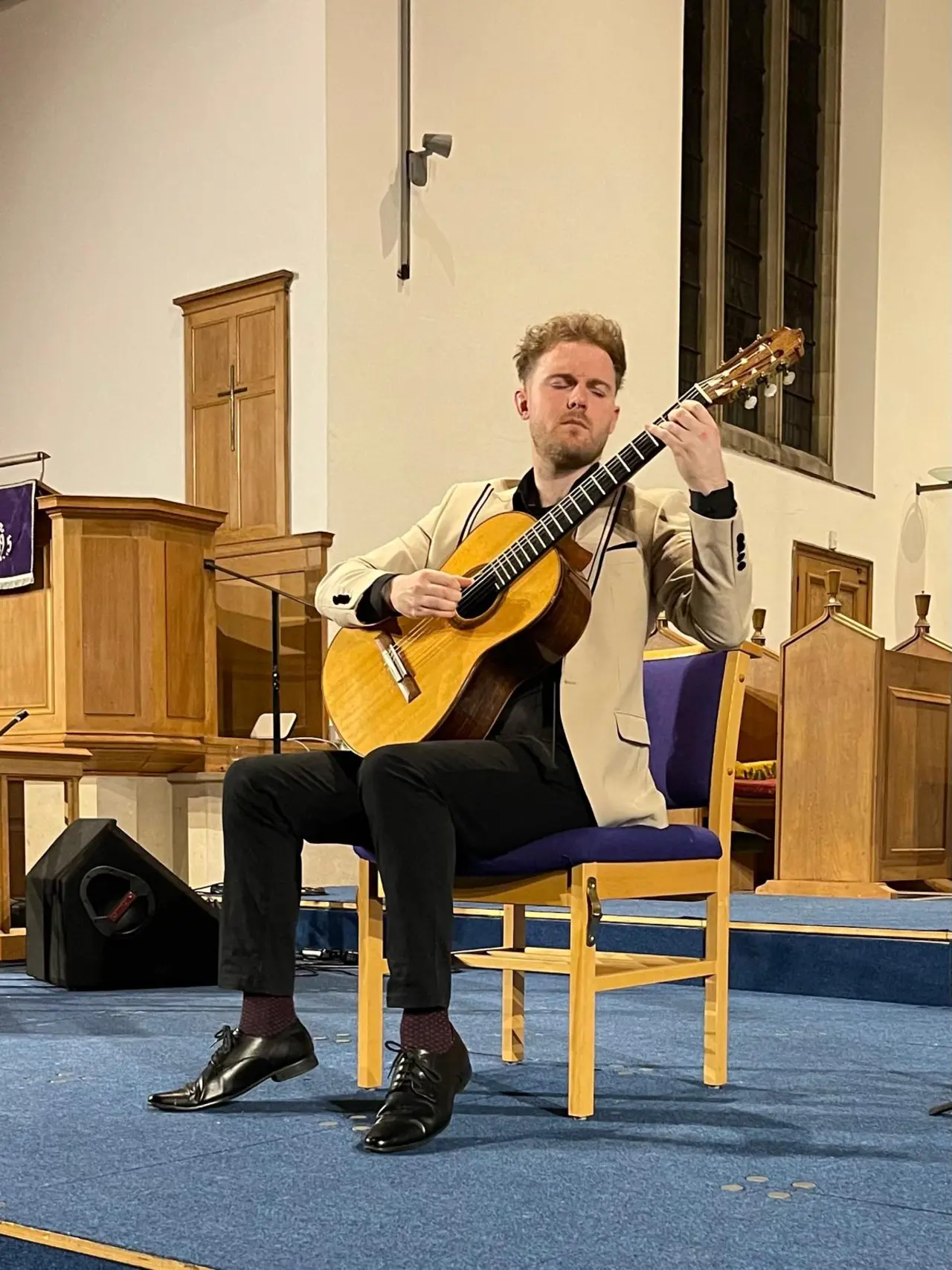
St Paul’s Church
Saturday 14th March 2026
Although Central and South America has furnished the world with a vast and celebrated output of music for the classical guitar, Jack Hancher’s recital was a rich and enjoyable reminder of the music that has grown up – and is still growing well, as this concert attests – within Europe. Jack’s ‘European’ concert drew upon both music originally composed for the guitar and music written for other instruments and transposed for the guitar.
He opened tonight’s recital with two movements from Johann Sebastian Bach’s Partita No. 1 in B minor, BWV 1002. Composed in 1720 for solo violin, each of the four movements of this piece contains in effect two parts, hence the ‘Double.’ The Double offers a musical elaboration of the chords used in each of the four movements. It was a beautiful way to open the concert. Jack’s Sarabande/Double was silky smooth, like flowing water, whereas his Bourree/Double was full of nimbleness and sparkle.
Composed 250 years after Bach’s Partita, the Englishman Malcolm Arnold’s Fantasy for Guitar offers a highly contrasting contemporary, but nonetheless, highly structured, piece of music. Commissioned by Julian Bream and written in 1971, Arnold not only wrote it for Bream, for his style of playing, but, as Arnold wasn’t a guitarist himself, it was created in close collaboration with the maestro. In introducing the piece, Jack described it as having a pyramidal structure, with the Fughetta acting as its top and centre movement, and the three movements either side mirroring each other. It is a wonderful guitaristic piece, with Jack really wringing out from his lovely instrument every ounce of full-bodied resonance in the opening and ending sections, as well as a floating, dreamy, meditative lightness of expression in the central Fughetta.
Jack ended the first half of his recital with a piece by Laura Snowden. Placing it here in the program brought to the fore the complex web of relations involved in guitar history as well as musical composition: the Bream for whom Arnold composed his Fantasy was a direct mentor to Snowden, from whom Jack commissioned The Memory Garden. And as Jack explained, the inspiration behind Laura’s piece are her experiences of walks and talks and stories with her grandmothers as a child. In his performance of Laura’s beautiful piece of music, Jack very ably conjured up a feeling of loving togetherness, of play and innocence, of time and distance, and of circular repetition; as if the musical itself embodied the experience of having a cherished memory.
The entire second half of Jack’s concert explored the work and interplay between 20th century French and Spanish composers, as well as the interplay between the piano and guitar. He opened with Debussy’s much cherished La Fille Aux Cheveux Lin (The girl with the flaxen hair). Composed in 1910 and forming part (Prelude No. 8) of Book 1 of Debussy’s significant 24 preludes for solo piano, La Fille Aux Cheveux Lin is a very beautiful piece of music. One would be forgiven for assuming that this piece was composed for the guitar: as Jack’s performance of it illustrated, his instrument’s superlative dynamical range, tonal colour graduations, and harmonical effects imbued Debussy’s music with magical charm.
Jack followed this with Spanish Falla’s 1920 tribute to Debussy (following his death in 1918). Homenaje pour Le Tombeau de Claude Debussy was Falla’s only piece written specifically for the guitar. Widely appreciated as a masterpiece for the guitar, it is a piece that interweaves French and Spanish musical elements, reflective of Falla’s residence, and musical development, in Paris from 1907-14. In his performance of this piece, Jack illustrated a wonderful boldness in his execution of the deep and resonant open chords, prior to returning to his exquisite gentleness of touch for its ending. Finishing this trio of pieces, Jack returned to one of Debussy’s compositions for piano, his earliest one in fact – from 1880 – providing for us a very robust, earthy, and lively recital of Danse Bohémienne.
Composed in 1912-13, Ravel’s À la Manière de Borodin (In the way of Borodin) is another offering from Jack that foregrounds the rich cross-fertilisation of composers, cultures, people and instruments – specifically the piano – in early 20th century Europe. In collaboration with the Italian Alfredo Casella (1833-1947), the French composer Ravel created four musical pastiches for piano in the style of important contemporary composers. Alongside this one in the style of the Russian composer Borodin, Ravel also composed a pastiche in the style of Emmanuel Chabrier. At about one and a half minutes long, it’s a lovely miniature with a dense dance (waltz) -like feel, very suited to Jack’s ability to play in a beautifully understated way.
Also originally composed for piano is Catalonian Frederico Mompou’s Canción No. 6. It comes from his Cançons i Danses, a collection of 15 songs and dances composed across much of the composer’s lifetime, between 1918 and 1972. Like most of the collection, Cancion No. 6 was composed for piano, and was dedicated to the great Polish-American virtuoso Arthur Rubinstein. It is a hauntingly beautiful piece, and, in Jack’s very capable hands, is suited exceptionally well to the guitar. Further elaborating his web of European musical connections and interrelations, Jack ended his trio of pieces composed for piano with Spanish Albeniz’s Capricho Catalán (one connection here being the celebration of the region of fellow composer Mompou’s Catalonia).
Jack ended his recital with a masterpiece of 20th century music written for the guitar. Composed in 1933 (just three years prior to his death by firing squad execution), Antonio Jose’s Sonata for Guitar illustrates this composer’s unique voice. His work was highly admired in his lifetime, with Ravel (another French connection) commenting that Jose ‘will become the Spanish composer of our century’. The Sonata is a brilliantly crafted work with four well-defined movements unified by recurring harmonic-thematic elements, demanding a virtuosic ability by the performer. Jack rose to the occasion admirably, providing us with a tour de force at all levels. It was a wonderful way to end his fascinating program of European music.
Despite giving us so much already, Jack was generous enough to respond to the audience’s desire for an encore. Traversing one more time back over the Pyrenees, to France, and back to a work originally composed for piano, in 1893, Jack treated us to Erik Satie’s Gnossiennes No. 1. Being Satie’s most well known work, not only is it a very beautiful piece, and one that works wonderfully on the guitar, but it also has the understated, dreamy and mesmeric atmosphere that Jack is so brilliant at creating, as he showed us again and again in this uplifting recital.
Programme
Johann Sebastian Bach (1685–1750)
From BWV 1002
Sarabande/Double
Bourrée/Double
Malcolm Arnold (1921–2006)
Fantasy for Guitar
Prelude
Scherzo
Arietta I
Fughetta
Arietta II
March
Postlude
Laura Snowden (b. 1993)
The Memory Garden
Interval
Claude Debussy (1862–1918)
La Fille aux Cheveux de Lin
Manuel de Falla (1876–1946)
Homenaje pour Le Tombeau de Claude Debussy
Claude Debussy
Danse Bohémienne
Maurice Ravel (1875–1937)
À la Manière de Borodin
Federico Mompou (1893–1987)
Canción No. 6
Isaac Albéniz (1860–1909)
Capricho Catalán
Antonio José (1902–1936)
Sonata for Guitar
Allegro Moderato
Minuetto
Pavana Triste
Finale