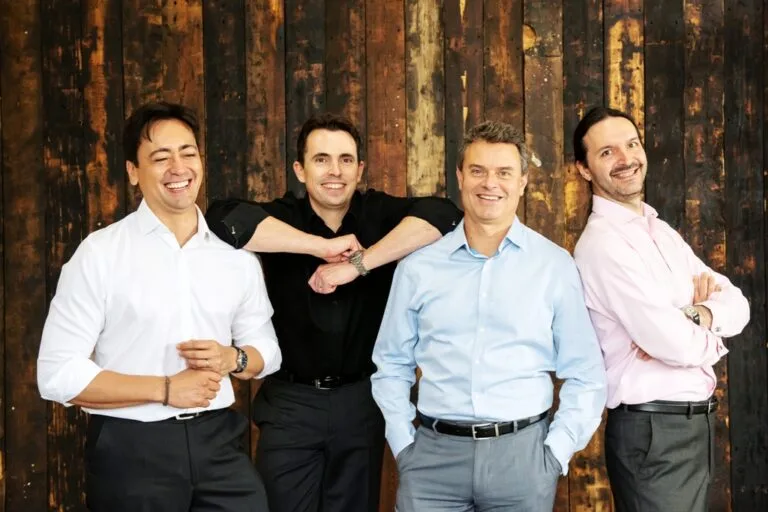
Mike Baker, Vasilis Bessas, James Jervis, Craig Ogden
St Paul’s Church
Saturday 13th June 2026
Aquarelle opened their recital with a very energetic and exciting piece by the celebrated Brazilian composer and guitarist, Paulo Bellinati. Originally composed in 1989 for soprano saxophone with guitar, piano, bass, and drums, it was then adapted for guitar trio; then again for guitar quartet. What is most distinctive about Bellinati’s music is its fusion of classical techniques with Brazilian folk rhythms – in this case, the ‘baião’. Inspired by the game of marbles (popular amongst children at the time of the piece’s composition), being full of energy and rhythm, Baiao de Gude was an uplifting way to begin the concert, as well as a showcase of the Aquarelle’s highly integrated and virtuosic musicianship.
This was followed by the very interesting Six Fish, composed in 2003 by Nigel Westlake. Not only is Westlake a household name in his native Australia, but given that he penned the scores for the Babe films, he is a composer whose music has been heard by cinema goers the world over. The six movements making up the whole are each dedicated to a fish, each with its individual character. Almost as if the music moves between different locations in a watery underworld, its movements are by turns playful, gentle, darting, discordant, meditative, and searching. To add musical depth to this underworld, one member of the quartet (Mike) used a guitar made of steel (a ‘dobra’), whereas another member (Craig) used a 12 string acoustic guitar; further colour was added by the use of the slide (Mike), the scratching of the bass strings (Vasilis), and drumming (James). The overall effect was to create a three dimensional, shimmering, resonating sound world.
The selection of pieces by Elliott Goldenthal were from his Academy and Golden Globe Award winning soundtrack for the 2002 film, Frida, a biopic of the Mexican artist Frida Kahlo. Originally composed for an ensemble of vihuela (small Mexican guitar), classical guitar, guitarron (Mexican bass guitar), accordion, Mexican harp, marimba, and glass armonica, Mike Baker arranged the three pieces for four guitars. In introducing the selection, he explained that he was inspired by both the film (Aquarelle are all art-house film lovers), as well as by the art of Frida Kahlo. Segued into each other, Mike has arranged a wonderful piece of music. From a loving (duo) lament at the beginning, which is echoed and developed by the quartet, it moves into a spirited dance accompanied by clapping and high registered rhythms. It slows down into a reflective spaciousness, transforms into a shimmering, airy interlude, before ending with a muscular and multi-faceted rhythm. It was brimming with Latin passion.
Taking further inspiration from the art and culture of South America, Aquarelle’s next piece was again originally a homage to an artist. Ariel Ramirez composed Alfonsina y el mer in tribute to
the Argentine poet, Alfonsina Storni. With lyrics by Felix Luna, the song enjoys great popularity in Latin America. This arrangement of it for four guitars is by the great classical guitarist and composer Roland Dyens. It is an exquisitely beautiful piece and was played by Aquarelle with deep warmth and longing.
Aquarelle ended the first half of their recital with a dazzling piece from Cuba’s foremost guitarist composer, Eduardo Martin. Hasta Alicia Baila (‘Until Alicia Dances’) was the product of the composer’s desire to inspire his friend Alicia to dance. And it is certainly an electric piece of music, full of driving rhythms and movement – indeed, the piece is in the form of the Cuban Rumba, ‘guaguanco,’ which involves both a call and response between the instruments, as well as a plethora of percussive effects. Aquarelle really rocked through this piece, leaving audience members uplifted and delighted.
After refreshments, Aquarelle opened the second half with Mike’s transcription of a piece by Andy Scott, who is a personal friend of the quartet. Salt of the Earth started out as a three movement concerto for tuba and brass band. It’s a real fusion of genres, including folk, funk, and latin jazz. It began with wonderful percussive rhythms (through hitting the guitar body in various ways), rhythms that came and went throughout this very lively piece. It also had a remarkable dynamism which was augmented by the melodies being passed between each of the four players.
A mi pueblo (‘To my village’) is a beautiful composition by the Paraguayan harpist Ismael Ledezma. Mike transposed it from harp to guitar quartet (which also led to another version which includes voice accompaniment with guitar quartet). It’s very soulful music. Next was Manha de Carnaval (‘Carnival Morning’), written by the Brazilian guitarist and composer Luiz Bonfa for the film Black Orpheus. Although Manha de Carnaval exists in several versions (instrumental, sung, hummed), Vasilis transposed it for guitar quartet. Bonfa’s original music has become a Bossa Nova classic and Vasilis’s transposition of it is wonderful: rich, multi-layered, multi-voiced, by turns melodic and boldly rhythmical.
Staying with Bossa Nova, Lamento no Morro (‘Cry from the Hills’) is by the celebrated Brazilian composer, Antonio Carlos Jobim, one of the persons credited with the creation of this style of music (from the amalgam of samba and cool jazz in the 1960s). Although it is quite a short piece, it is full of groove and sparkle. Music that urges your body to move.
Aquarelle performed the next two pieces as a pair, but in reverse order from the program. Contemporary Belarusian-American, guitarist and composer, Olga Amelkina-Vera’s Nebulae cleverly conjures up space and time on a vast scale. Although it was performed with real verve, in introducing the piece it was explained that it is very hard to play as a quartet due to each member needing to play in a different time signature! The contemporary American guitarist-composer David Pritchard’s Stairs similarly conjures up space and time in a minimalist style. Composed for four guitars, it creates a hypnotic never-ending effect, with a gentle and gradual sense of variation, movement and change.
The Scottish harpist and composer, Catriona Mckay’s Swan is a very beautiful piece written for harp and transposed by Mike for four guitars. With a very strong celtic and folk feel, Swan is
graceful and fluid, evoking peace and rest, the sort of music that it would be great to have as a backdrop to one’s daily life. Aquarelle stayed with the folk sound world to end the concert, but in this case a trio of pieces – or rather movements – by the American guitarist-composer Scott Tennant. Although the lilting melody of the first movement of Celtic Fair has a very traditional British Isles feel, its subsequent movements have a very different vibe, a much more North American folk sound world, with its Appalachian and Bluegrass overtones. It was a hot-blooded, robust and foot stomping way to end the recital.
Yet Aquarelle responded generously to the sustained applause. Staying with the very upbeat mood created by their rendering of Tennant’s Celtic Fair, they treated us to their version of Frenchman Bireli Lagrene’s wonderful Made in France. It was yet another uplifting piece: with overflowing, exuberant music, dazzling guitaristic excellence, and an exhibition of brilliant and dedicated teamwork.
Programme
Paulo Bellinati – Baião de Gude
Nigel Westlake – Six Fish
I. Guitarfish
II. Sunfish
III. Spangled Emperor
IV. Sling-jaw Wrasse
V. Leafy Sea Dragon
VI. Flying Fish
Elliot Goldenthal (arr. Mike Baker) – Themes from Frida (Solo Tu / The Floating Bed / Portrait of Lupe)
Ariel Ramírez (arr. Roland Dyens) – Alfonsina y el mar
Eduardo Martín – Hasta Alicia Baila
Interval
Andy Scott (arr. Mike Baker) – Salt of the Earth
Ismael Ledezma (arr. Mike Baker) – A mi pueblo
Luiz Bonfá (arr. Vasilis Bessas) – Manhã de Carnaval
Antonio Carlos Jobim (arr. Markus Tardelli) – Lamento no Morro
David Pritchard – Stairs
Olga Amelkina-Vera – Nebulae
Catriona McKay (arr. Mike Baker) – Swan LK243
Traditional (arr. Scott Tennant) – Celtic Fair (Daya’s Spin / Music for a Found Harmonium / Cat-Cow Reel)