St Paul’s Church
Saturday 14th June 2025
Composed in 1774, just prior to the birth of the first great classical composers for the guitar, such as Fernando Sor and Mauro Giuliani, the opening piece of this recital provided a fine example of how beautiful music written originally for the piano accumulates new dimensions when performed on guitar.
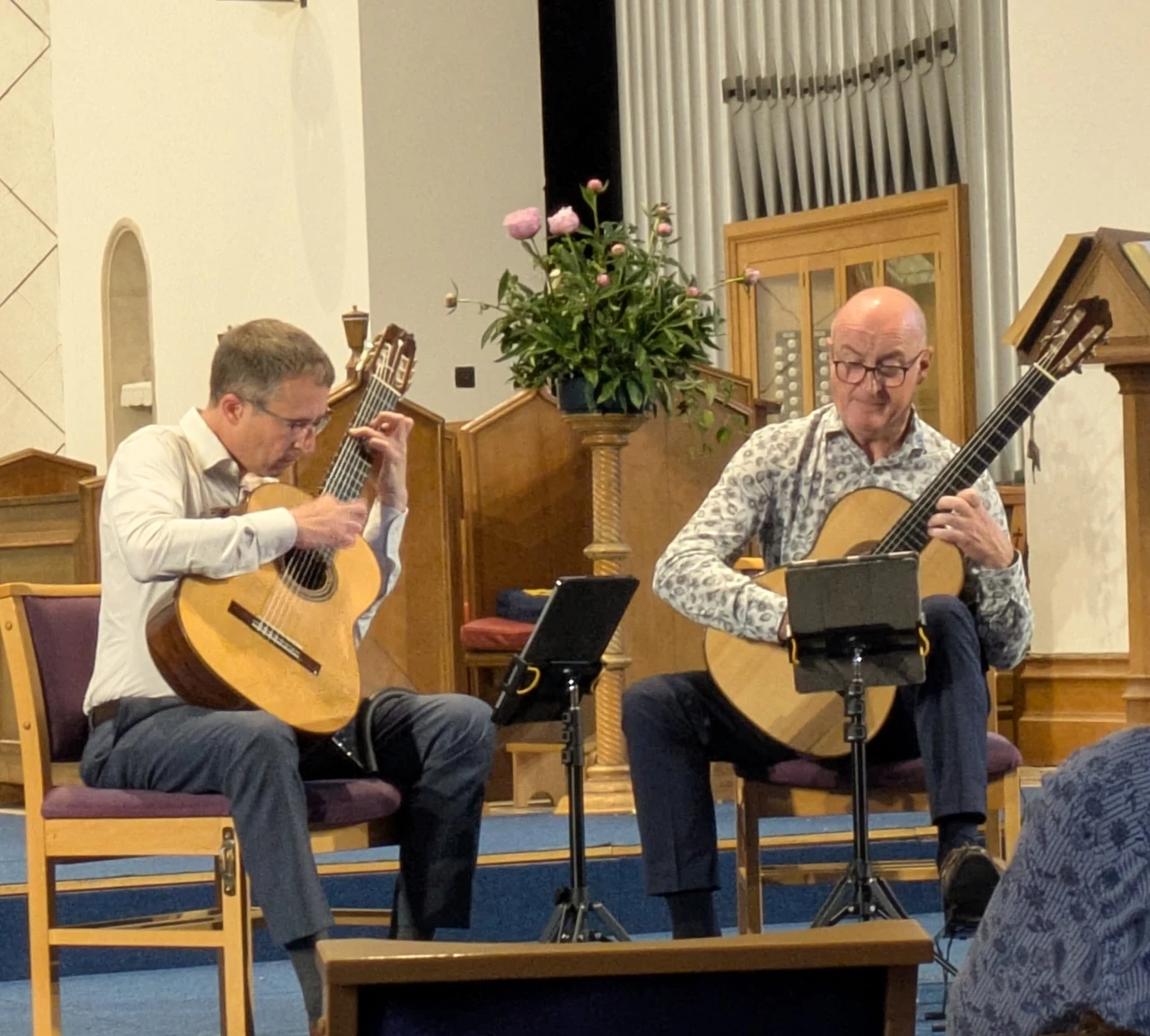
Mark Eden’s transcription of Mozart’s Sonata No. 4, together with Eden–Stell Duo’s performance of it, made vivid the music’s strongly dialogical character, wherein each voice is pitted against the other in a — by turns — loving, dancing, teasing, and competitive match.
Composed in 1962, almost two hundred years after Mozart’s Sonata No. 4, Mario Castelnuovo-Tedesco’s Les Guitares bien Tempérées (1974) is a masterwork of composition for two guitars. Inspired by, and a tribute to, J. S. Bach’s The Well-Tempered Clavier, it has been described as the longest and most important cycle of works ever composed for two guitars.
In the piece as a whole, there are 24 prelude–fugue pairs, and tonight we were treated to the initial six. If Eden–Stell’s opening piece brought out the dialogical character of Mozart’s Sonata, in this series we had an intense, searching conversation, wherein the two voices were engaged in an almost continuous interlacing, interpenetrating, harmonic exploration and development.
Given that Les Guitares bien Tempérées was written for the Duo Presti–Lagoya, it is fitting that it was followed by a piece composed by Ida Presti. As well as being celebrated as a virtuoso performer, Presti is also considered a first-rate composer for the guitar. Eden–Stell’s wonderful performance of Étude Fantastique intimated both: not only is the music fantasia-like, fascinating for its constant shifts in rhythm and changes in melody — whilst integrating a range of stylistic influences — but it also required, and exhibited, a flawless interweaving of playing wherein the musicians seemingly merged into one living, breathing source of sound.
Eden–Stell opened the second half of their recital with the oldest piece in their program. The Concerto in D is of both eminent and unique provenance: J. S. Bach’s 1715 composition for harpsichord was in fact a transcription of an Oboe Concerto by his contemporary Marcello; which Chris Stell, in turn, arranged for guitar duet.
The long journey this music took to the guitar was worth it:
the Andante was played with a gorgeous alternation of firm touch and singing lightness (spiccato);
its haunting Adagio was imbued with a profundity due to the extent of colour contrast offered by two guitars (one of which — Chris’s — has a deep bass provided by a 7th string);
and its Presto rang out and flowed with the wonderful resonance of sound that is unique to spruce-topped guitars.
Turning to a very different sound world, Eden–Stell’s next offering was a selection of pieces by the 20th-century Armenian composer Arno Babajanyan. From Bach’s formal, Western European Baroque, we were invited into a quiet reflective space, rich in human emotion and Middle Eastern culture.
The pieces selected were from the beginning (Prelude, Impromptu) and end (Elegy) of Babajanyan’s output. Although each of these short pieces was meditative and hypnotic, the last one was filled with a powerful sense of loss and mourning.
To end their program, Eden–Stell stayed within the 20th century, but this time within the atonal sound world of André Jolivet. With their program nodding once again to their esteemed forebears, Sérénade pour deux guitares (1956) was commissioned by Duo Presti–Lagoya.
Eden–Stell described the Sérénade as “unique in its sonic originality, showcasing Jolivet’s command for the guitar’s harmonic scope, tone colour, texture, and articulation … in short, it is a masterpiece of extraordinary originality.”
The deep respect Eden–Stell have for both Jolivet’s composition, as well as Duo Presti–Lagoya’s contribution to the history of the guitar, could be seen, heard, and felt in every note of their performance of the Sérénade.
Indeed, Eden–Stell’s rendition of Sérénade constituted the final part of a masterclass concert of exceptional skill and verve, dedication to the guitar and its history, and teamwork coordinated at the level of breath.
For the audience of this wonderful recital, it allowed for a celebration of enormous musicality.
Programme
Wolfgang Amadeus Mozart (1756–1791)
Sonata No. 4 K282 (arr. Mark Eden)
- Adagio
- Minuet I / Minuet II
- Allegro
Mario Castelnuovo-Tedesco (1895–1968)
Preludes and Fugues from Les Guitares bien Tempérées
- Prelude and Fugue I – G minor
- Prelude and Fugue II – D major
- Prelude and Fugue III – A minor
- Prelude and Fugue IV – E major
- Prelude and Fugue V – B minor
- Prelude and Fugue VI – F♯ major
Ida Presti (1924–1967)
Étude Fantastique
INTERVAL
Johann Sebastian Bach (1685–1750)
Concerto in D BWV 974 (after Marcello, arr. Chris Stell)
- I. Andante e spiccato
- II. Adagio
- III. Presto
Arno Babajanyan (1921–1983)
Three Pieces (arr. Chris Stell)
- Prelude
- Impromptu
- Elegy
André Jolivet (1905–1974)
Sérénade pour deux guitares
- I. Preludio e canzona
- II. Allegro Trepidante
- III. Andante Malinconico
- IV. Con Allegria